
When is a Fashion Ad Fatigued—and What Should You Create Next?

For fashion brands, the question isn't just "which ad is winning?" but "which creative is starting to fade, and what should we generate next?" This article breaks down the manual, reactive cycle of creative refresh and introduces a data-led, AI-powered creative learning loop to systematically combat Meta ads creative fatigue.
- Identify the leading indicators of creative fatigue before they impact ROAS.
- Analyze creative attributes to understand why an ad worked.
- Build a continuous loop of generation, testing, and learning.
- Connect creative performance to your next generation of AI-powered visuals with Performance Loop.
A fashion brand may have hundreds of creatives running on Meta, but the most expensive question is not which ad is winning. It's which creative is starting to fade, why it's fading, and what should be generated next. Relying on last-click ROAS to answer this is like driving by looking in the rearview mirror; by the time the lag indicator has dropped, you've already wasted significant spend. The real cost of creative fatigue isn't just the underperforming ad—it's the missed opportunity to learn from it, a mistake that compounds with every dollar spent on guesswork.
Understanding the Warning Signs of Meta Ads Creative Fatigue
Creative fatigue is a predictable decay in performance that occurs when an audience has seen an ad too many times. While it ends with a drop in Return on Ad Spend (ROAS), the damage starts much earlier. The key is to monitor the leading indicators, not the final result. According to industry benchmarks, an early warning is when frequency on prospecting campaigns rises above 2.5 and is paired with a significant drop in Click-Through Rate (CTR) (Prooflytics, 2024). Watching these signals together provides a much earlier and more accurate diagnosis. An intelligent monitoring system doesn't just look at one metric, but the relationship between them, as fatigue is a pattern, not a single number.
- Rising Frequency: This is the root cause and the earliest signal. Frequency measures the average number of times a user has seen your ad. For prospecting campaigns targeting cold audiences, a frequency creeping above 2.5 within a 7-day window is a yellow flag. For retargeting, audiences are more tolerant, but a frequency above 5-6 still warrants close attention. High frequency isn't inherently bad if performance holds, but it's the soil in which fatigue grows.
- Declining Click-Through Rate (CTR): This is the first real performance casualty. As users become over-exposed, they start to tune the ad out. A week-over-week drop of 15-20% in CTR, especially when correlated with rising frequency, is a strong sign that the creative's hook has worn off. The ad is still being served, but the audience is no longer compelled to click.
- Increasing Cost per Click (CPC) and Cost per Mille (CPM): As engagement (clicks, reactions, shares) drops, Meta's auction often charges more for the same placement. The algorithm prioritizes ads that users engage with, so when engagement falls, your cost to reach people (CPM) and to get them to click (CPC) will rise. This is the ad tax for being ignored.
- Increasing Cost per Acquisition (CPA): Fewer, less-interested clicks mean conversions become more expensive. This is a mid-stage signal that overall efficiency is degrading. Your ad might still be generating sales, but the cost to acquire each customer is creeping up, eroding your margin with every conversion.
- Performance Deterioration Over Time: The most crucial signal is the pattern. A creative that once performed well showing a steady decline across these metrics is the classic sign of fatigue. Meta's own research confirms that by the fourth time a user sees the same ad, the likelihood of a conversion drops by approximately 45% (Analytics at Meta, 2023). This decay is not linear; it often accelerates, making early detection vital.
Why simply replacing a tired ad is a multi-million dollar mistake
The default reaction to a fatigued ad is to swap it with a new one. This is a reactive, inefficient approach that burns budget and creative resources. Let's take a running example: a Meta campaign for a fictional "Aura" midi dress. The winning creative for the last three weeks has been a static image of a model in a city scene at golden hour. Performance is now declining.
A typical team might brief their agency for "something new." The agency, lacking deep data, produces a video of the same dress, or another static shot with a different model. This is a gamble. It fails to address the core question: why did the first ad work? Was it the model's confident pose, the aspirational urban environment, the warm and inviting lighting, the direct framing, or the "Shop the Look" call-to-action? Was it a combination? Which element stopped working? Without knowing, you're just guessing. This is where learning from the ad before replacing it becomes the central strategy. For a brand spending $100k a month, not learning from ad performance is a high-stakes error. Replacing an ad without learning is like throwing away the answer key to your next test. Over a year, this "guess-and-check" approach can lead to millions in wasted ad spend and creative production costs.
What defines an AI-powered creative learning loop?
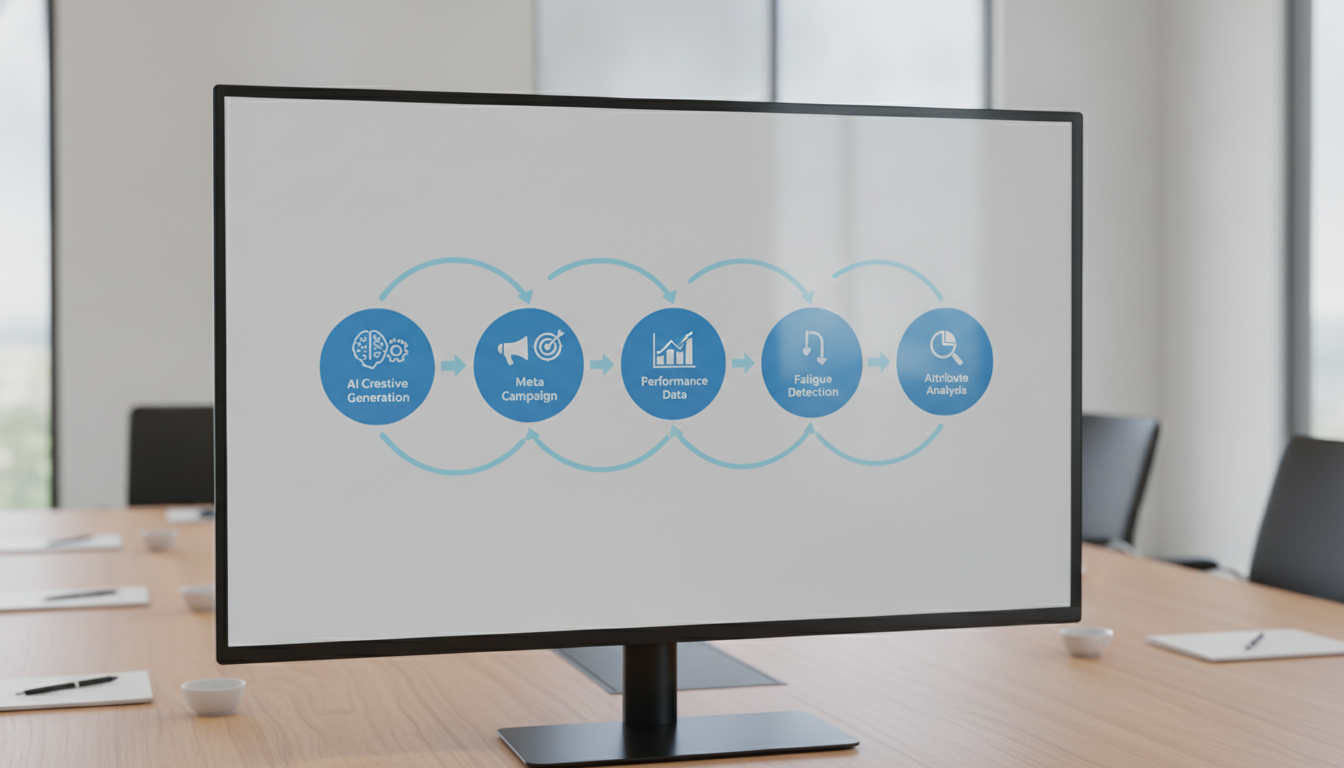
A creative learning loop transforms this guesswork into a systematic, data-driven process. Instead of a linear path from creation to fatigue, it's a continuous cycle that gets smarter with each iteration. This is not just a theoretical concept; it's an operational workflow that high-growth brands are implementing to gain a competitive edge.
AI-generated garment creative → Meta campaign → performance data → fatigue detection → attribute analysis → next creative generation
This model shifts the focus from producing more ads to producing smarter ads. It uses performance data not just to judge an ad's success, but to inform the next generation of creative. It's a fundamental move from a production mindset to an intelligence mindset. The loop ensures that every dollar spent on advertising also generates valuable data that makes the next dollar more effective. It turns your ad account into a research lab, constantly discovering what resonates with your audience.
Analyzing Creative DNA: What separates a winning ad from a fading one?
To learn from a creative, you must first break it down into its core components or "Creative DNA." By tagging each creative with these attributes, you can start to correlate specific elements with performance metrics. This moves the analysis beyond the holistic ad to its constituent parts, revealing deeper insights that are impossible to see at the campaign or ad set level. This granular analysis is where true competitive advantage lies.
| Attribute | What to Analyze | Example for the "Aura" Dress |
|---|---|---|
| Model | Pose (walking, static, sitting), ethnicity, age representation, direct vs. indirect gaze, smiling vs. neutral expression. | Did the walking pose outperform the static pose? Do creatives with a direct gaze have a higher CTR but lower conversion than indirect? |
| Hook | Opening copy line, headline, first 3 seconds of video, value proposition (e.g., style, comfort, versatility). | "Your new favorite dress" (product-focused) vs. "Effortless summer style" (benefit-focused). Which hook drives a lower CPA? |
| Scene | Studio with solid color background, urban/cityscape, nature/outdoors, indoor/lifestyle, abstract/graphic background. | The urban background had high initial CTR, but data shows nature scenes ultimately convert at a higher rate for this product. |
| CTA | Button text (Shop Now, Learn More), overlay text in the creative, directness of the ask in the copy. | "Shop Now" might have the highest click volume, but analyzing post-click data might show "Shop the Collection" leads to a higher Average Order Value (AOV). |
| Format | Static image, video (and its length), carousel, collection ad, user-generated content (UGC) style. | Carousel ads show higher AOV as they encourage browsing, while short-form video has the best top-of-funnel engagement and lowest cost per view. |
This level of analysis is crucial. For instance, data from fashion ad analyses shows that enriched Dynamic Product Ads (DPA) with real-model shots and outfit context can double ROAS compared to generic catalog images with plain backgrounds (QuickAds.ai, 2026). Without attribute analysis, you would never uncover such a specific, revenue-driving insight. You would be stuck A/B testing broad concepts, while your competitors are optimizing the specific visual elements that drive purchases.
Where Performance Loop Connects Creative to Performance
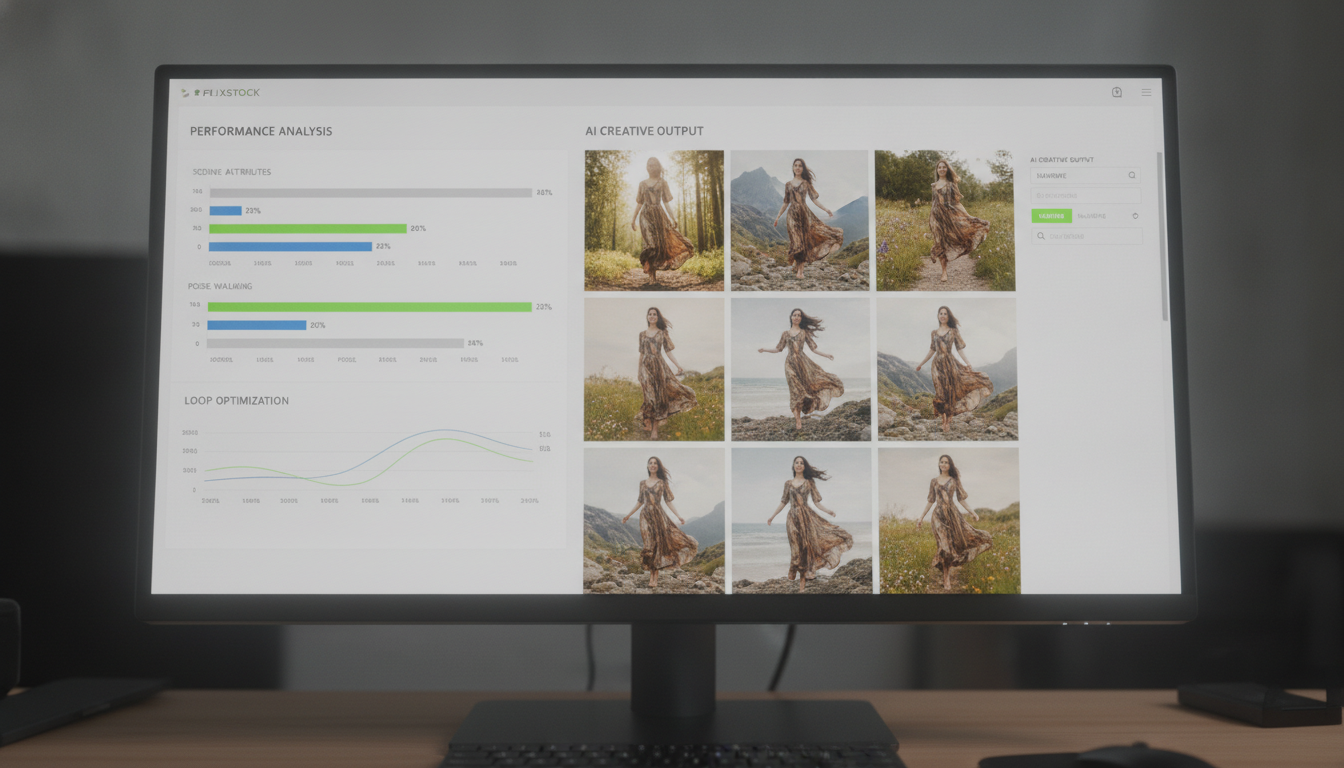
This is where an AI ad performance and creative platform becomes essential. Manually tracking fatigue signals and creative attributes across hundreds of ads is not scalable. Performance Loop automates this entire process. The platform connects directly to your Meta Ads account via API, monitoring performance data in near real-time. It automatically flags creatives showing signs of fatigue based on a multi-signal model, alerting you days before the drop in ROAS becomes critical. More importantly, it provides a simple interface to tag all your creatives with their attributes (model, scene, hook, etc.) and provides an analytics layer to see which elements are driving performance. It surfaces insights like "creatives with a 'walking pose' have a 30% higher conversion rate" or "urban scenes are fatiguing, but nature scenes are still performing well." It answers not just "what's fading?" but "what's working and why?"
Generating the Next Wave of Creatives with AI
Once Performance Loop provides the data-driven insights on which creative attributes to double down on, the next step is generation. Instead of briefing a new photoshoot, which is slow, expensive, and often misses the specific data-informed requirements, brands can turn to AI-powered visual creation platforms like FlixStock. Using the original, high-quality product photo of the "Aura" dress as an input, FlixStock can generate dozens of new visual variations based on the winning attributes identified by Performance Loop. If the data shows that "nature scenes" and "walking poses" have the highest conversion rate for the target audience, you can generate a new batch of creatives featuring the dress in various lush, outdoor settings with models in dynamic motion, all without a single reshoot. This closes the creative learning loop: insight from performance data directly and precisely informs the next generation of AI-powered creative, reducing waste and dramatically accelerating the speed of iteration.
Can you test new creative without resetting the learning phase?
A common mistake when refreshing creative is to pause the existing ad set or campaign and start a new one. This resets the learning phase in Meta's algorithm, leading to several days of inefficient spend while the system re-learns which users to target. The correct, evidence-based approach is to add the new creative variations into the existing, fatigued ad set. Meta's own research provides causal evidence for this: in an experiment across 26,000 ad sets, adding fresh creative to a fatigued ad set caused a direct, measurable improvement in conversion rates (Analytics at Meta, 2023). This allows the campaign to retain its history and learning while giving the algorithm new assets to test against the same audience, ensuring a smoother, more efficient transition. Think of it like swapping a tired player out of a game rather than forfeiting and starting over. By adding 3-5 new, data-informed creatives to the ad set, you give the algorithm enough new material to optimize delivery and find the next winner, often leading to a rapid recovery in performance.
Frequently asked questions
When should you refresh a Meta creative?
You should refresh a creative at the first sign of fatigue, typically when its frequency rises above 2.5 and its CTR drops by 15% or more week-over-week. For high-spend accounts (over $5,000/month), this can happen as quickly as every 7 days. Don't wait for ROAS to drop; act on the leading indicators.
How do you identify what made a creative work?
You identify what made a creative work by breaking it down into its core attributes (model, scene, hook, CTA, format) and tagging it in a performance analytics system. By analyzing a large number of creatives, you can correlate these attributes with performance metrics like CTR and conversion rate to find statistically significant patterns.
How do you generate a replacement ad creative with AI?
You use insights from creative attribute analysis to write a specific brief for an AI image generation platform. For fashion, this involves using a high-quality product photo as a base and instructing the AI to generate new scenes, models, and styles based on the data of what has performed best previously. This moves from random generation to data-driven creation.
How can I avoid repeating the same fatigue pattern?
Avoid repeating fatigue patterns by diversifying your creative attributes. If your data shows that studio shots are fatiguing, test a batch of outdoor or user-generated content (UGC) style creatives. The creative learning loop is designed to prevent this by continuously feeding new, data-informed ideas into your campaigns instead of iterating on a single concept until it fails.
How do you test a new ad creative effectively?
The most effective way is to add new creative variations into an existing, live ad set. This avoids resetting Meta's learning phase. Add 3-5 new creatives at once to give the algorithm enough options to test. Monitor performance closely over the first 72 hours to identify early winners and pause any clear underperformers.
References
- Analytics at Meta — Creative Fatigue: How advertisers can improve performance by managing repeated exposures (2023)
- Prooflytics — Meta Ads Creative Fatigue: Detection and Fix Guide (2024)
- Koro Blog — [2025 Guide] 15 Fashion Ad Examples That Scale ROAS (2025)
- QuickAds.ai — D2C Fashion & Apparel Creative Intelligence Report (2026)
- Adsgen.ai — Creative Fatigue on Meta Ads: How to Spot It and Fix It