
Why Flat Lays Kill ROAS: The Case for AI On-Model Ads
In this article
Brands need on-model presentation to drive conversions, but the cost and slowness of physical shoots bottleneck creative testing. This article reveals how AI on-model imagery breaks this gridlock for performance marketing teams.
- The financial cost of creative fatigue in fashion ads
- Why AI on-model ads outperform traditional product photography
- A testing framework for market-specific creative variants
- How to scale creative velocity with Performance Loop
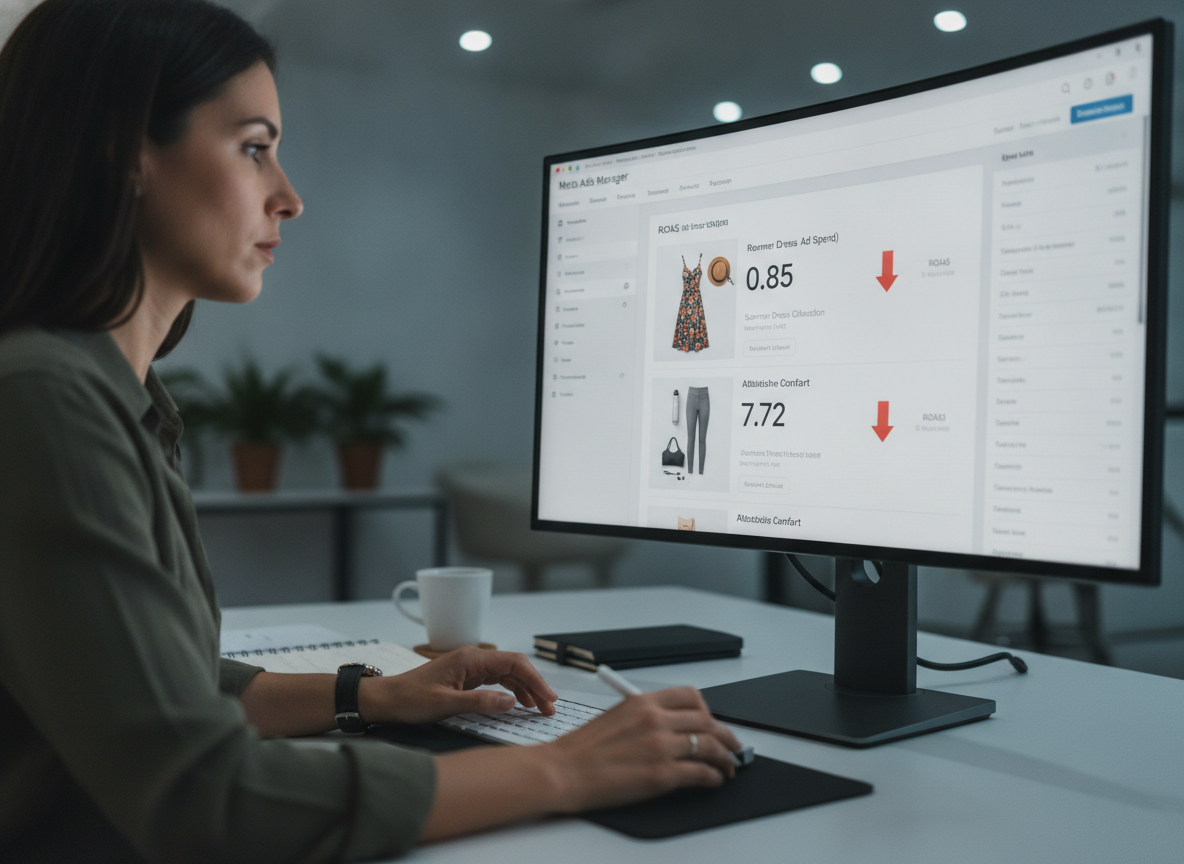
Are your Meta ads burning budget on creative that doesn't convert? The difference between a 1.2x and a 3.0x ROAS in fashion eCommerce is rarely the targeting—it is almost entirely the creative. According to WISEPIM (2026), fashion e-commerce converts at just 2.2%. To beat the baseline, you need compelling, relatable on-model imagery, not lifeless flat lays.
What creative fatigue costs a fashion brand at scale
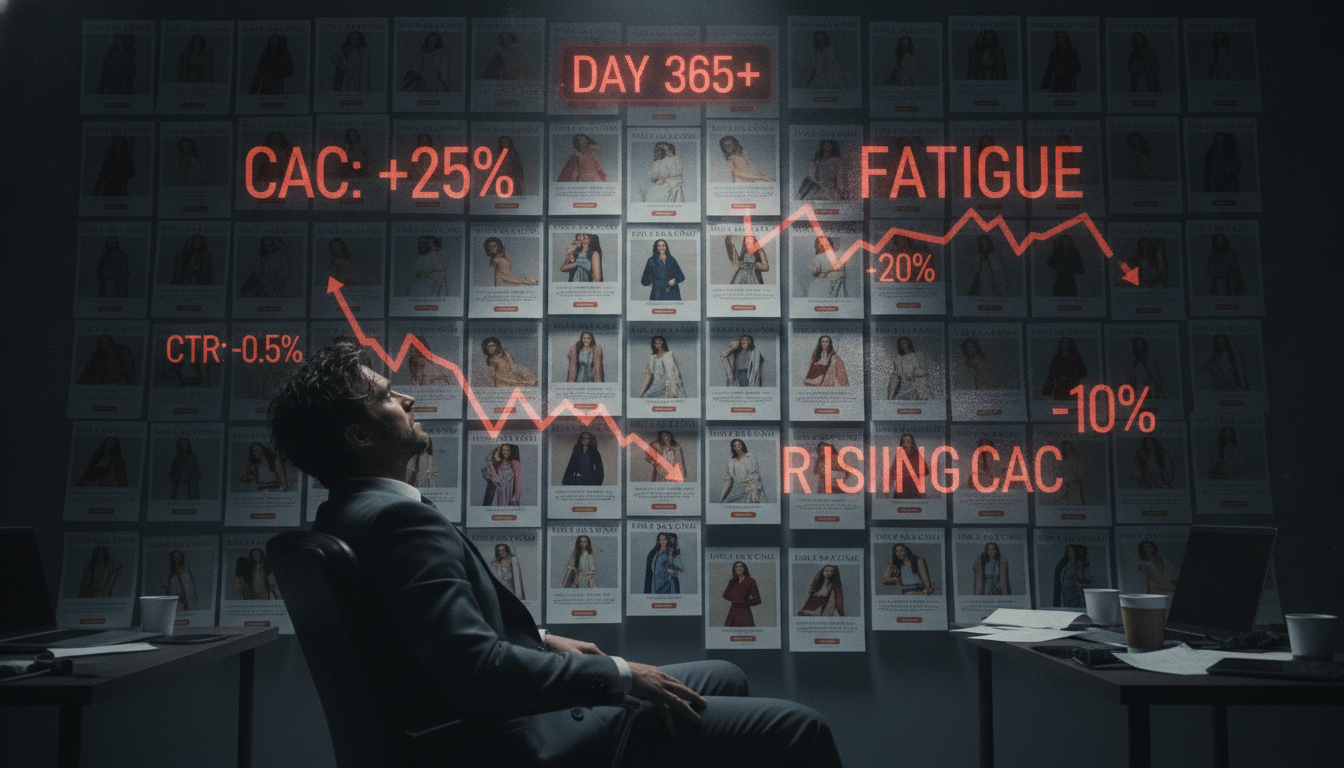
Running the same static campaign images rapidly exhausts your audience. When creative fatigue sets in, Click-Through Rates (CTR) plummet while Customer Acquisition Costs (CAC) spike. The traditional response is to schedule another photoshoot, which takes weeks and thousands of dollars, leaving your ad account bleeding cash while you wait. With fashion returns costing the industry £7 billion in the UK alone (ScienceDirect, 2024), performance marketers cannot afford to drive traffic with low-information flat lays that fail to set accurate product expectations.
Why on-model relevance determines ad ROAS
A flat lay forces the shopper to imagine how the garment fits. AI on-model imagery removes that cognitive load. When an ad shows a garment on a model that reflects the target market's demographic and seasonal reality, engagement rises. It is the core principle of AI ad performance and creative for fashion eCommerce: relevance drives the click, and accurate representation protects the margin post-purchase. Every returned order eats $30 to $40 in fully loaded costs (Eightx, 2026), making upfront visual clarity a performance marketing necessity.
The strategy top-performing fashion brands execute differently
The fastest-growing DTC apparel brands have stopped relying on slow studio pipelines. Instead, they leverage AI on-model ads to generate hundreds of variations from a single source image, feeding the Meta and TikTok algorithms exactly what they crave: volume and variety.
| Creative Strategy | The Slow Approach (Traditional) | The Growth Approach (AI On-Model) |
|---|---|---|
| Creative Testing Velocity | 2 - 3 new concepts per month | 50+ variations tested weekly |
| Ad Fatigue Response | Wait for the next seasonal shoot | Instantly generate new model/background combos |
| Market Localization | Generic global campaign imagery | Hyper-localized models and settings |
A step-by-step playbook for testing market-specific creative

- Identify your top 10 bestselling products that currently rely on flat lay ads.
- Generate AI on-model variations featuring different demographics and settings.
- Launch a dynamic creative testing structure in Meta, grouping by visual angle.
- Allocate 20% of your budget to pure creative exploration over a 14-day window.
- Scale the winning combinations into your core evergreen campaigns.
How Performance Loop automates creative learning at scale
Performance Loop watches every creative you run, identifies the visual elements driving conversion, and automatically generates the next batch of winning assets. By integrating AI on-model generation directly into your performance data, Performance Loop ensures your ad account never starves for high-ROAS creative again.
Metrics to track after launching localized creative variants
When transitioning from flat lays to AI on-model ads, the primary leading indicator is an immediate bump in CTR (aim for a 30-50% relative increase). Following that, monitor your CAC and ROAS. Additionally, collaborate with your merchandising team to track the return rate of cohorts acquired through these new ads—better visual context at the top of the funnel should yield more confident, profitable purchases downstream.
Frequently asked questions
Why do flat lay ads perform poorly on Meta and TikTok?
Flat lays lack human context. In feed-based platforms where users are scrolling rapidly, faces and dynamic human poses stop the scroll much more effectively than static garments on a white background, leading to higher CTR and lower CAC.
How does AI on-model imagery combat creative fatigue?
AI allows performance marketers to rapidly generate new ad variations—swapping models, backgrounds, and styling—without a new photoshoot. This provides the algorithms with fresh creative to test, extending the lifespan of the campaign.
Does improving ad creative lower apparel return rates?
Yes. By setting accurate expectations around fit and drape in the initial ad touchpoint, you attract higher-intent buyers. With fashion returns costing £7 billion in the UK ([ScienceDirect, 2024](https://www.sciencedirect.com/science/article/pii/S1366554524004952)), this is a critical profitability lever.
How many creative variations should a fashion brand test weekly?
Top-tier growth teams test upwards of 30 to 50 creative variations per week. This velocity is virtually impossible with traditional photography but highly achievable when leveraging AI to multiply a single source image into dozens of contextual ads.
What is the true cost of an ecommerce return?
Beyond the lost revenue, an average apparel return costs the merchant between $30 and $40 in reverse logistics, processing, and markdown losses ([Eightx, 2026](https://eightx.co/blog/real-cost-of-returns-calculator-2026)). Accurate, localized ad creative helps filter out bad-fit buyers early.
References
- WISEPIM — Fashion & Apparel E-commerce Statistics & Benchmarks (2026)
- ScienceDirect — The billion-pound question in fashion E-commerce: Investigating the anatomy of returns (2024)
- Eightx — Real cost of returns calculator: what each refund actually costs (2026)
- Color Experts International — Clothing Photography for eCommerce: Ideas, Tips, Style (2026)
- NRF — Consumer Returns in the Retail Industry (2025)