Facebook Ads Best Practices That Actually Move the Needle in 2026
The definitive Meta ads best practices for fashion e-commerce rely on feeding the algorithm high-quality data and fresh creative. Knowing how to run Facebook ads today means leveraging broad targeting, Advantage+ shopping campaigns, and dynamic video content to execute a profitable Facebook ads strategy.
Teams using AI ad performance and creative for fashion eCommerce consolidate creative testing, budget pacing, and cross-channel reporting so Meta campaigns improve without manual spreadsheet work.
Facebook Ads Strategy: Campaign Structure & Meta's AI Setup
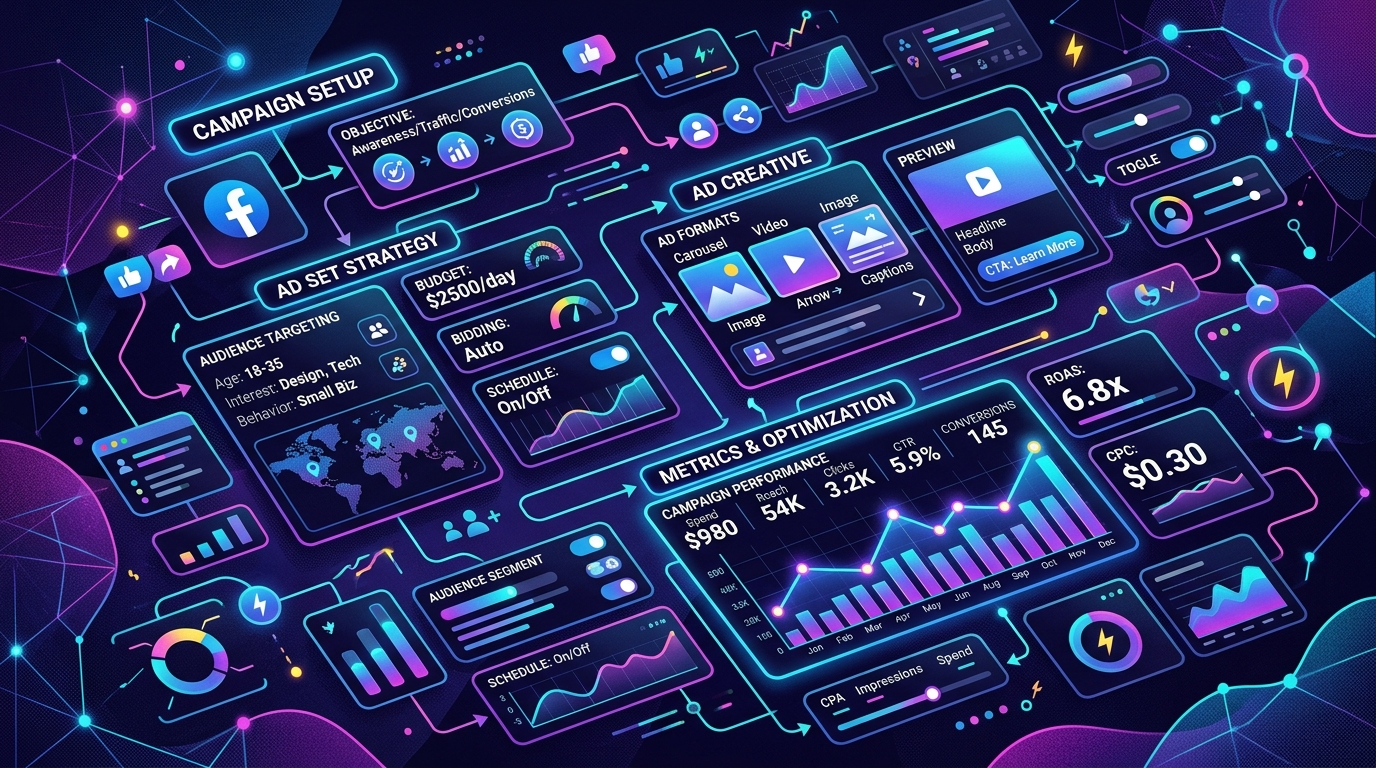
Modern Facebook ads strategy for fashion brands starts with a simplified Meta ads campaign structure. Instead of fragmenting budget across dozens of ad sets with narrow interest stacks, consolidate prospecting into Advantage+ shopping campaigns with broad targeting Facebook ads. Meta needs roughly 50 weekly purchase events per campaign to exit learning—fewer, larger structures reach that threshold faster than hyper-segmented accounts.
Server-side tracking through Meta Conversions API setup closes the attribution gap iOS privacy changes created. Pair pixel events with CAPI purchase signals so your Advantage plus audience strategy optimizes on real revenue, not inflated browser clicks. Facebook ads budget optimization works best at campaign level with cost cap or minimum ROAS targets once you have 14 days of stable conversion data.
Advantage+ Setup Checklist
- Consolidate ad sets into a single Advantage+ campaign.
- Enable broad targeting without restrictive age or interest constraints.
- Implement Meta Conversions API (CAPI) to capture server-side events — see our first-party data guide.
- Set budget optimization at the campaign level.
| Campaign Type | Use Case | AI Reliance |
|---|---|---|
| Advantage+ Shopping | E-commerce product sales at scale | High |
| Standard Conversions | Specific targeted promotions | Medium |
| Retention | Cart abandoners and past purchasers | Medium |
Facebook Ad Creative Best Practices for Meta Ads
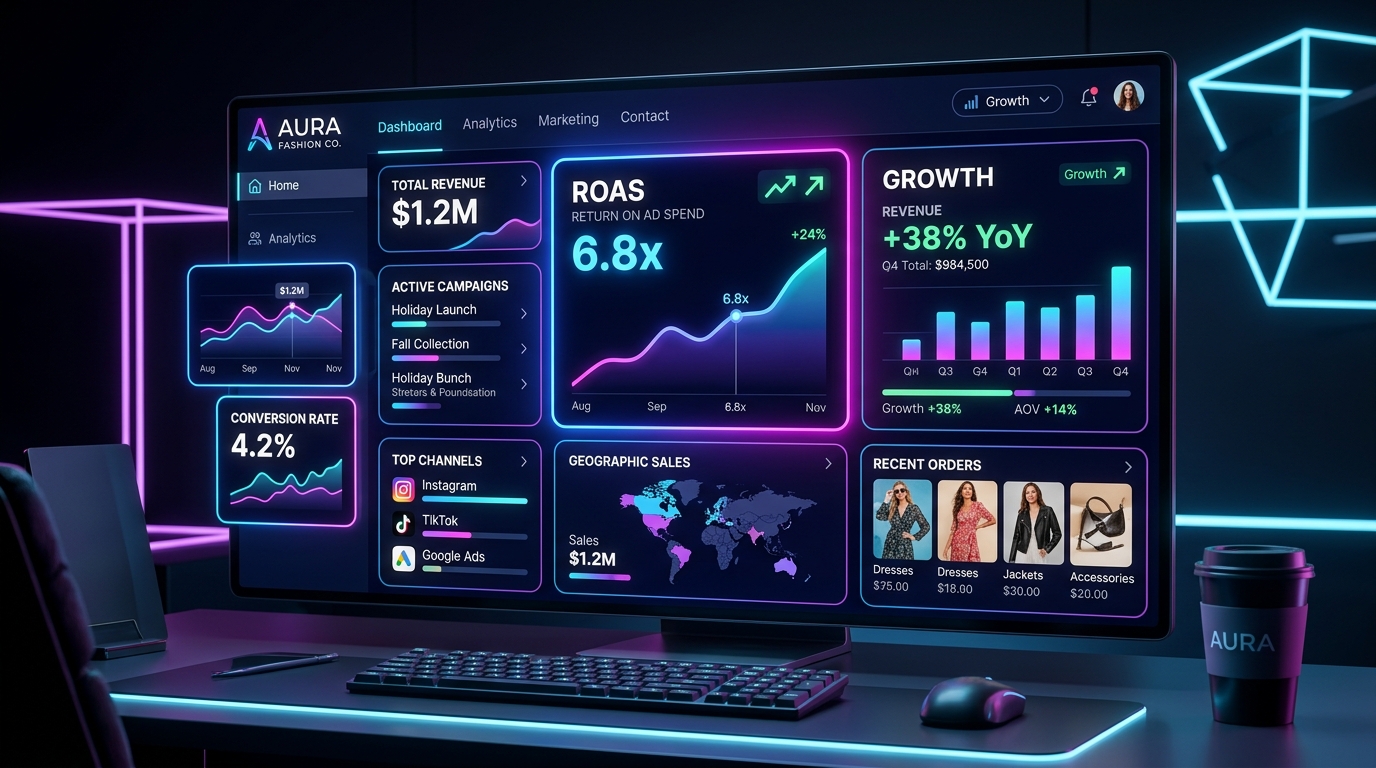
Facebook ad creative best practices for apparel brands start with format diversity. Test Reels-first video, carousel lookbooks, and UGC-style stills in parallel—each Meta ad format reaches a different scroll behavior. High converting Facebook ad copy leads with a specific outcome ("Free returns on every order") before brand name; fashion shoppers decide in the first line.
User generated content (UGC) for Meta ads consistently outperforms studio shots in prospecting because it signals social proof. Rotate Facebook video ad hook ideas every 7–10 days to beat creative fatigue before frequency climbs above 2.5 on cold audiences. Document winning hooks in a creative library so your team scales variants without resetting campaign learning.
3 Video Hook Examples for Fashion
- "Stop scrolling. Here is the jacket you need for winter."
- "3 ways to style our best-selling dress."
- "Unboxing the most viral boots of the season."
| Ad Format | Best For | Refresh Cadence |
|---|---|---|
| Video (Reels) | Storytelling and engagement | Every 7–10 days |
| Carousel | Showcasing collections | Every 14 days |
| Static Image | Direct product focus | Every 14–21 days |
| UGC | Building trust and social proof | Every 7–10 days |
Troubleshooting: Lower CPA, Fix Conversions, Scale ROAS
Diagnosing underperformance requires a systematic approach to lower Meta ads CPA and resolve why Facebook ads are not converting. A disciplined Meta ads testing framework is essential to scale Facebook ads without losing ROI.
How to lower Meta ads CPA (Cost Per Acquisition)
Lowering CPA means diagnosing the funnel. If CTR is low, the creative hook is failing. If CTR is high but conversion is low, the landing page or offer is the bottleneck. Platforms like Performance Loop can automate creative testing to continuously find the lowest-CPA variations.
Why are my Facebook ads not converting
Conversion failures usually stem from audience-offer mismatch, severe creative fatigue, or a broken checkout experience. Ensure your broad targeting has enough conversion data via CAPI to optimize effectively.
How to scale Facebook ads without losing ROI
Scaling requires incremental budget increases (10–20% every few days) on stable, winning campaigns. Rapidly scaling budgets often resets the learning phase and temporarily tanks ROI.
Meta ads testing framework
Test one variable at a time. Start with the visual creative (video vs. image), then the hook (first 3 seconds), followed by the primary ad copy, and finally the offer (discount vs. free shipping).
| Symptom | Diagnosis | Action |
|---|---|---|
| High CPM | Audience too narrow or poor ad quality | Go broader, improve creative |
| Low CTR | Creative not resonating | Test new hooks and formats |
| Low Conversion Rate | Landing page friction or weak offer | Optimize site speed and offer |
References
- Meta Business Help Center, Advantage+ Shopping Campaigns, updated January 2026.
- Performance Loop internal benchmarks, Fashion e-commerce Meta ads, Q2 2026.
- Shopify Enterprise, E-commerce Benchmark Report, 2025.
Frequently asked questions
How to lower Meta ads CPA?
Lowering Meta ads CPA involves auditing your creative, tightening your Advantage+ audience parameters, and ensuring your Meta Conversions API (CAPI) is accurately feeding first-party data back to the platform.
Why are my Facebook ads not converting?
Facebook ads often fail to convert due to creative fatigue, broken landing page experiences, or restrictive targeting that prevents Meta's AI from finding high-intent buyers.
How to scale Facebook ads without losing ROI?
Scale Facebook ads by incrementally increasing budgets (no more than 20% at a time) on winning Advantage+ campaigns, while simultaneously launching fresh creative assets to prevent audience saturation.
What is the best Meta ads testing framework?
The best Meta ads testing framework isolates one variable at a time, testing distinct ad creative hooks against broad audiences before iterating on ad copy or specific offer structures.
How often should you refresh Facebook ad creative?
Fashion e-commerce brands should refresh Facebook ad creative every 7 to 14 days, as high-frequency campaigns rapidly experience creative fatigue which spikes acquisition costs.